

For most of the history of the data centre, battery backup lived in its own room. A central UPS conditioned incoming power for the whole hall, and when the grid failed, large battery strings carried the critical load for the seconds or minutes it took the generators to start. The batteries sat in a controlled environment, far from the servers, and were sized to serve hundreds of racks at once.
AI training clusters have changed the scale of the rack, and with it the place where backup power sits. In the Open Rack V3 (ORv3) architecture developed through the Open Compute Project, each rack carries its own power shelf, which converts AC to a common DC busbar at around 48 V, and its own shelf of battery backup units, or BBUs, connected to that same busbar. The battery has moved from the basement to the rack. The move changes what the battery is fundamentally asked to do: a BBU is a high-power device whose real test comes after years of standing still at full charge. That single fact shapes how its cells should be chosen, how its ageing should be judged, and how it should be managed once installed.
What is a rack BBU actually for?
It is often said that BBUs became necessary because GPU training loads swing so violently that only a battery next to the servers can hold the bus steady. That description is understandable but not quite accurate, and getting it right matters for everything that follows.
Short load swings are handled first by the rack's power supplies and by capacitance on the bus. Power supplies for ORv3 racks are designed to carry brief peaks above their rating; one published datasheet, for example, specifies a pulse-power envelope that the power supply must carry without triggering the BBU. Capacitors absorb the very fastest transients. The BBU is the next layer down. According to an engineering series by Analog Devices describing the ORv3 BBU requirements, a module switches to discharge when the busbar falls below 48.5 V for more than 2 ms, must take over within 2 ms, and must then supply 3 kW for up to four minutes. The BBU shelf described has six module slots, and the 3 kW, four-minute requirement must still be met after four years in service.
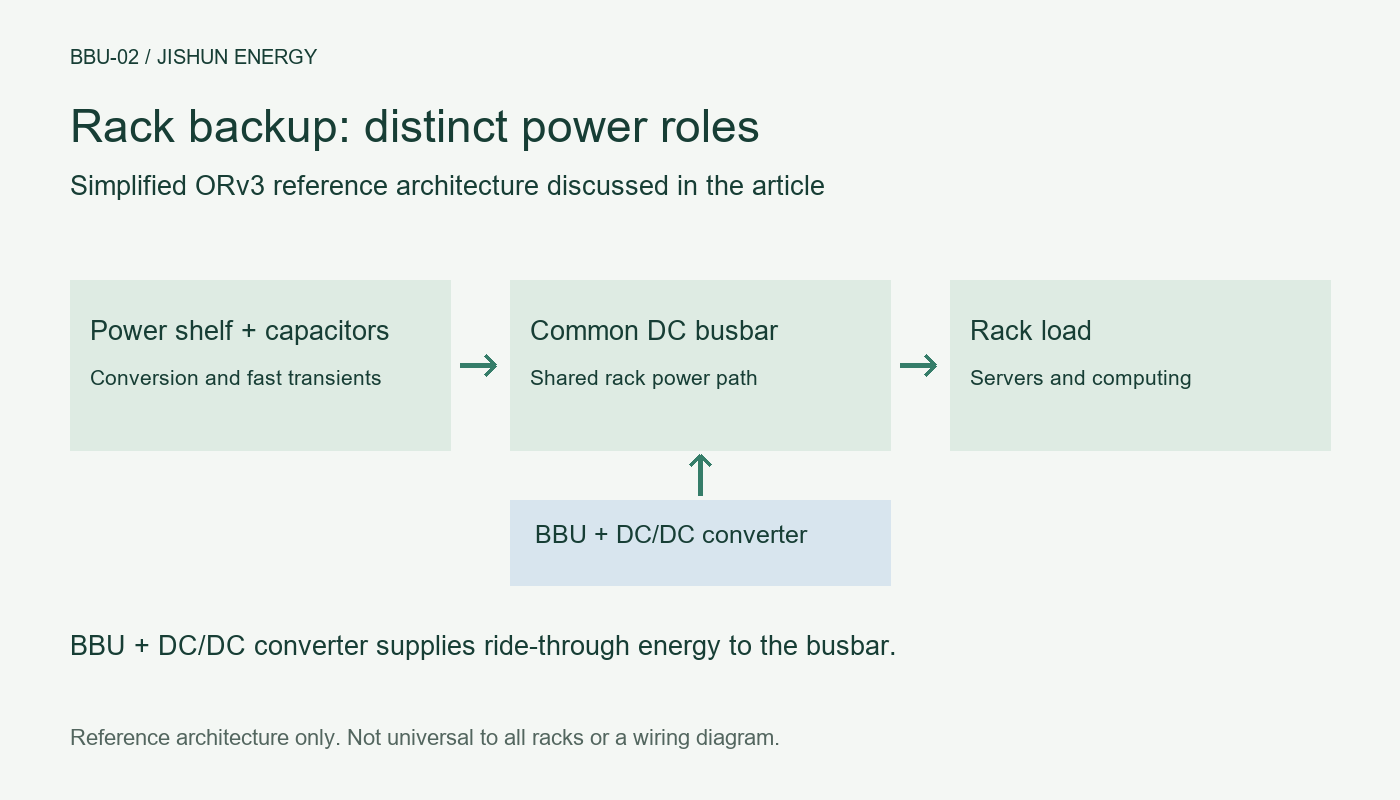
So the BBU's defining task is not smoothing every fluctuation of a training job. It is a fast, high-power ride-through when the rack loses its input, lasting long enough for upstream systems to recover or for the workload to be moved safely. Newer high-power designs do go further: one recent ORv3 power supply adds a pulse-management signal that lets it ask the BBU to share repeated GPU pulse loads. That is an added duty with its own consequences for cycling and ageing, not the core requirement.
Why is it a power problem rather than an energy problem?
Once the task is stated plainly, the arithmetic is simple. A module that must deliver 3 kW for four minutes supplies 3 × 4/60 = 0.2 kWh to the busbar. That is a small amount of energy. But the module must deliver it at the end of its service life, through a DC/DC converter that is not perfectly efficient, while staying above the converter's minimum input voltage. The reference design published for the ORv3 BBU shows what that means in practice: its pack uses 66 cells of the 18650 type, arranged as six parallel strings of eleven, each cell with at least 1.5 Ah of capacity and a continuous discharge rating of 30 A. Taking, for example, a typical nominal voltage of 3.6 V per cell, the pack's nameplate energy comes to roughly 0.35 kWh, so drawing 3 kW from it means discharging at about eight to nine times its nameplate capacity per hour. The specified cells must also sustain 30 A continuously from as little as 1.5 Ah of capacity, a rate of up to twenty times their capacity per hour.
That puts the BBU firmly among high-rate applications. Its size is set by how much power it must deliver, not by how much energy it must store. This is the reverse of the priorities in an electric vehicle or a grid storage system, where cells are chosen mainly for energy per kilogram or per unit of cost and are expected to cycle thousands of times. A BBU cell is chosen first for sufficient power, low internal resistance and stable voltage under heavy current, and it will cycle rarely. Most of its life is spent waiting.
What do years of waiting do to a power battery?
Waiting is not neutral for a lithium-ion cell. A BBU is held near full charge almost all the time, often in the warm air of a densely loaded rack, and the combination of high voltage and high temperature is the condition under which cells age fastest. Calendar ageing therefore dominates the module's life, and a cycle-life rating says little about how a BBU will perform after four years. Lowering the standby state of charge slows this ageing, but it also reduces the energy available at the moment of an outage. That is a trade-off the system designer has to make deliberately, with data for the specific cell.
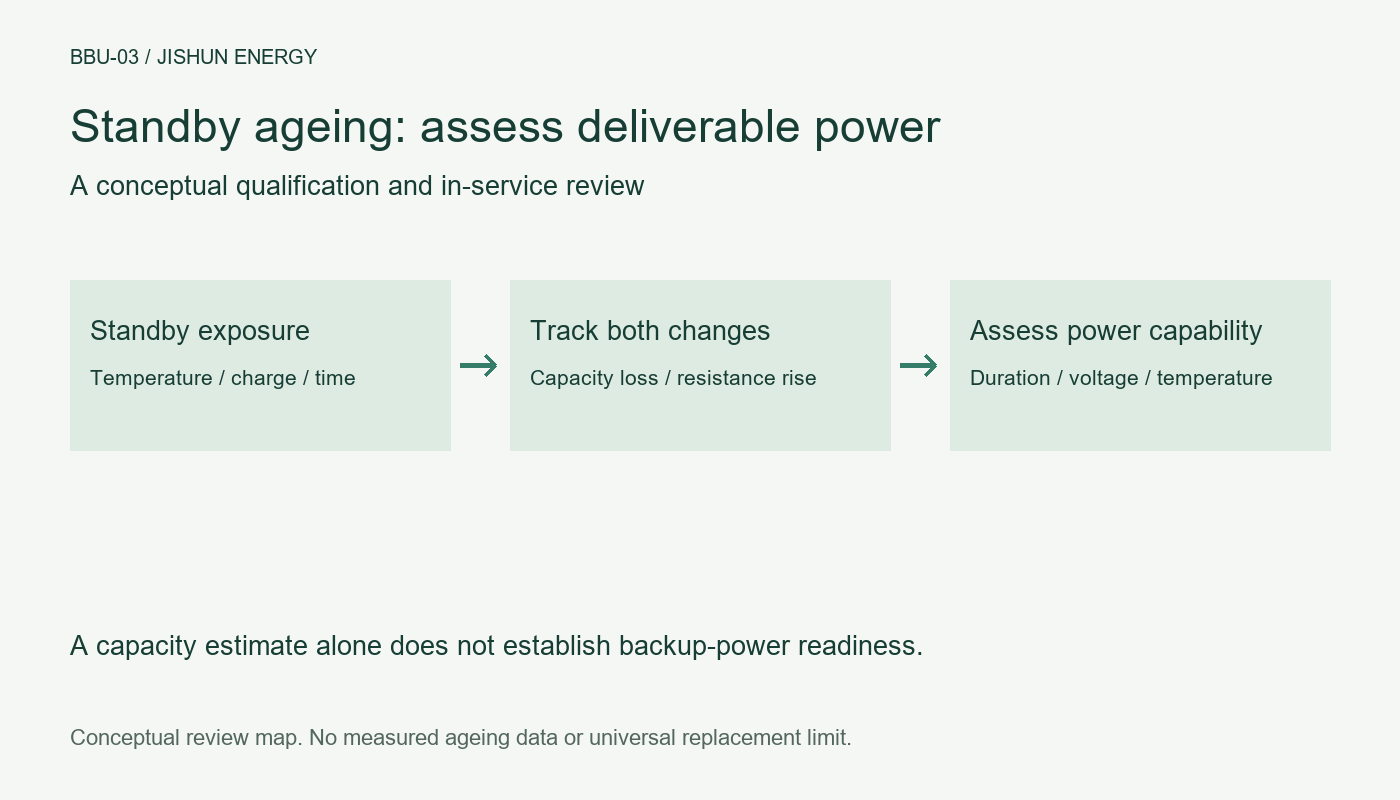
As a cell ages, two things happen together: its usable capacity falls and its internal resistance rises. Any serious ageing test measures both, because neither alone describes the cell's condition. What is distinctive about a BBU is which of the two ends its useful life. Because the module is sized for power, a rise in resistance can make it unable to deliver 3 kW without its voltage dropping below the converter's limit, even while it still holds much of its original charge. In a battery sized for energy, lost capacity is usually what eventually matters. In a battery sized for power, lost power capability can come first.
This is why qualification testing for a BBU cell should report not only capacity fade and resistance growth after storage at realistic standby conditions, but also what they mean in combination: the power the cell can still deliver, for the required duration, at the minimum bus voltage and at the temperatures the rack will actually see.
Why does management after installation matter as much as qualification?
Qualification establishes how a cell ages under controlled conditions. The harder problem is knowing, in a live data centre, whether a particular installed module can still do its job.
During standby, the easiest quantities to observe are charge level and, over time, estimates of remaining capacity. A monitoring scheme or replacement policy built mainly on those quantities can miss exactly the failure that matters most for a BBU: a module that appears healthy on charge and capacity but can no longer sustain rated power. The quantity a BBU management system really needs is state of power — how much power the module can deliver right now, for how long, before reaching a voltage limit. In practice this is tracked by measuring resistance through short current pulses during service, by running occasional discharge tests and accepting the small ageing cost they bring, and by adjusting predicted power for temperature. The replacement criterion follows naturally: a module should be retired when it can no longer deliver rated power at the minimum bus voltage, whatever its remaining capacity.
Seen this way, in-service monitoring is a continuation of the qualification test rather than a separate activity. The same two measurements, capacity and resistance, are followed through the module's life, and they are judged by the same yardstick: deliverable power.
What does this mean for cell chemistry?
The choice of chemistry follows from the same reasoning. The OCP reference design specifies lithium-ion cells of the 18650 type, and among lithium-ion power cells the differences that matter lie mainly in power density, in how they age when held at high charge, and in their thermal behaviour. Sodium-ion cells are sometimes proposed for backup duty. Their hard-carbon anodes tend to show a sloping voltage profile with noticeable polarisation, so the cell's voltage moves more with charge level and current. That does not rule them out, but it widens the voltage range the converter must accept while still delivering full power, and the decisive check is whether rated power can be maintained at the lowest voltage the cell reaches at the end of the backup window. Supercapacitors, finally, can take over the fastest and most frequent events in a hybrid design, leaving the battery to cover the longer ride-through.
Conclusion
Moving backup power into the rack does more than shorten the electrical path. It turns the backup battery into a compact, high-rate device that spends years at full charge and must then deliver its full power within milliseconds. Its size is set by power, its life is set mainly by calendar ageing, and its end of life often shows up first as lost power capability rather than lost capacity. A specification for a BBU cell or module should therefore start from rated power at end of life, at the minimum bus voltage and across the rack's temperature range; ask for calendar-ageing data that reports capacity, resistance and the resulting power capability together; and define in advance how state of power will be monitored in service and when a module will be replaced. Evaluated on those terms, the right cell is the one that can still do its job on the day it is finally needed.
References
1. Analog Devices, "Smart Battery Backup for Uninterrupted Energy, Part 1: Electrical and Mechanical Design," Analog Dialogue. https://www.analog.com/en/resources/analog-dialogue/articles/smart-battery-backup-for-uninterrupted-energy-part1.html
2. Advanced Energy, "50 V 3 kW Open Rack V3 PSU" datasheet (pulse-load operation without triggering BBU). https://www.advancedenergy.com/getmedia/b530c4fb-6ef2-4d50-8296-24a02c9501fd/ENG-50V-3kW-OPEN-RACK-V3-PSU-235-01-04-27-22.pdf
3. Advanced Energy, "Open Rack V3 5.5 kW 50 V HPR PSU" datasheet (pulse load management mode). https://www.advancedenergy.com/getmedia/a0b372ed-7676-4d99-ae69-810fe673007f/ENG-50V-5-5-kW-OPEN-RACK-V3-HPR-PSU-06-27-26-Logo-without-R.pdf
4. Delta Electronics, Battery Backup System product page (3 kW BBU: 4 minutes at 3 kW after 4 years of service). https://www.delta-americas.com/en-US/products/Power-Management/12018