

On 19 April 2025, the first humanoid robot half-marathon in Beijing showed how far these machines still had to go: only six of the twenty teams finished, the winner took two hours and forty minutes. In a retrospective account reported by Xinhua, Xing Boyang of Humanoid Robot (Shanghai) Co., Ltd. described five to six battery replacements during the previous year’s race, each taking three to four minutes and requiring a full system restart. On 19 April 2026, at the same race, Honor's robot Lightning finished in 50 minutes and 26 seconds, faster than the men's world record, and needed only one battery change, at the 10.6-kilometre mark. Yan Bin, chief architect of Honor's New Industry Incubation Project, described the power needed to drive its legs as equivalent to that of a high-performance car. Even the winning robot could not cover 21 kilometres on a single battery. At that level of power, the question is not only how much energy a battery stores, but how much of it the battery can still deliver.
That is the central point of this article. A humanoid robot does not stop working when its battery is empty. It stops when the battery can no longer deliver the next burst of power without its voltage falling below the cutoff. Runtime, the number every product announcement leads with, is therefore not a separate property to be traded against power. It is largely decided by power, and a battery that struggles with the robot's peaks will waste much of whatever energy it is given.
Those peaks are the defining feature of a legged robot's load. Standing up, lifting, catching a stumble or climbing a step produces short, intense demands across many joint motors at once. For example, a rough estimate for a 50 kg robot jumping 30 cm gives about 250 J delivered in a quarter of a second, around 1 kW of mechanical power on average and a few kilowatts of electrical power at the peak once motor losses are included. In practice, peaks should be specified from measured bus-power traces of the actual robot rather than from estimates or quoted numbers. Even a few kilowatts is a heavy draw on a typical humanoid pack. Unitree's H1, a full-size humanoid of about 47 kg, carries a quickly replaceable 864 Wh battery and is listed for up to two hours of continuous operation; drawing, for example, 3 kW from a pack that size would mean discharging at three to four times its capacity per hour.
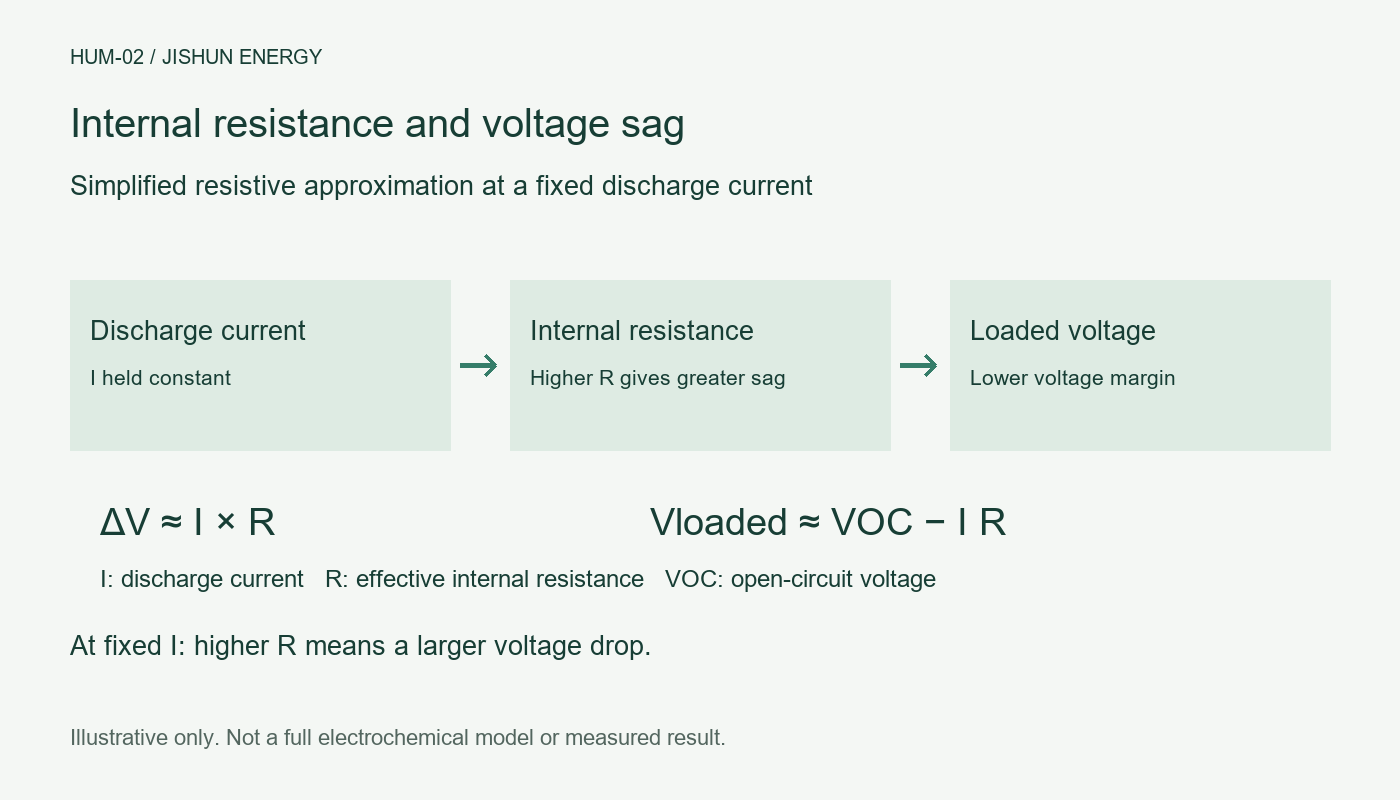
Each peak pulls the battery voltage down by the current multiplied by the internal resistance, and this is where power turns into runtime. Take, for example, a nickel-rich cell carrying 15 A during a peak, with a cutoff of 3.2 V. At 10 mΩ it sags by 0.15 V and can keep serving peaks until its resting voltage falls to about 3.35 V, near the bottom of its charge. At 20 mΩ it sags by 0.3 V and must stop at about 3.5 V, with roughly ten percentage points more of its charge still inside and unusable. The same resistance also burns energy: at 15 A, the 20 mΩ cell turns 4.5 W into heat during every peak, twice as much as its lower-resistance counterpart, in a pack enclosed in a torso with little airflow. Heat accelerates ageing, and ageing raises resistance. A battery that is weak in power therefore loses runtime three times over: in charge it cannot use, in energy it turns into heat, and in the faster decline of both over its life.
These losses do not simply add up; they reinforce each other, and they peak together at the end of a cold shift on an ageing pack. Low charge means lower voltage, so each peak needs more current. Cold raises the resistance that current must pass through; if, for example, it doubles in the case above, the 20 mΩ cell must stop at a resting voltage near 3.8 V, with more than half its charge unused. Ageing raises resistance again, and the extra heat speeds the next round of ageing. A robot's real runtime is set at this worst combination of low charge, low temperature and end of life, under its actual peak profile. A specification that quotes capacity at room temperature and gentle discharge describes a battery the robot will never quite have.
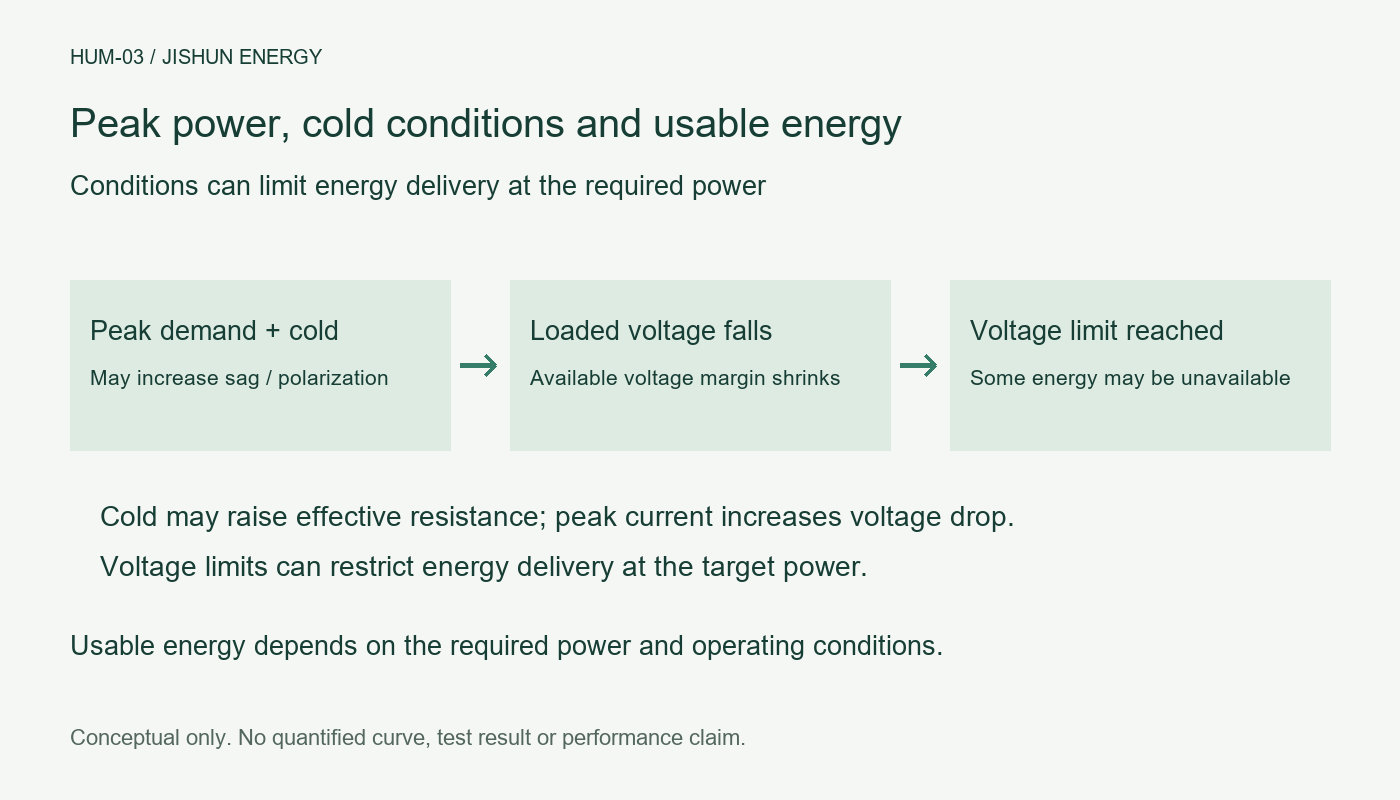
For a legged robot, the worst moment is also a safety problem. If the voltage sag at the end of a cold shift pushes the bus below the drives' undervoltage limit mid-motion, the drives can shut down, and a robot that needs active control to stay upright can fall. ISO 25785-1, the safety standard now at Committee Draft stage for this class of machine, defines it in exactly those terms: robots that require active control to remain balanced and could become unstable without power. A more conservative cutoff prevents the fall but strands still more energy, which brings the designer back to the same quantity: the power the battery can deliver at its weakest point. The same logic holds when power flows back. When the robot lowers itself, walks downstairs or brakes a limb, its motors return current to the battery. A full battery cannot accept it, a cold one can accept little without risking lithium plating, and a high-resistance cell turns more of it into heat. The energy that is not recovered is dumped in a braking resistor, and if the bus voltage rises too fast the drives can trip on overvoltage, which is just as dangerous for a balancing robot.
This also explains why adding cells, the usual answer to short runtime, helps more than its extra watt-hours alone would suggest. More cells in parallel share each peak, so every cell carries less current, sags less, heats less and strands less energy. But the extra mass raises the power the robot needs to move, and the gain shrinks with every kilogram. For example, with 500 W average power, a 90 percent usable window, 80 percent capacity at end of life and 180 Wh/kg at pack level, four hours of work already needs a pack of about 2.8 kWh and 15 kg, and eight hours roughly doubles it. Practical designs therefore pair a moderate pack with hot swapping, as the H1 does, or with opportunity charging during idle time, and both depend on power capability: a swapped pack still has to serve the robot's peaks near the end of its charge, and opportunity charging needs cells that accept high current without ageing quickly.
The choice of cell follows directly. A cell optimised for energy stores more watt-hours per kilogram, but if its resistance is high relative to the robot's peaks, more of those watt-hours will be stranded, lost as heat or lost to faster ageing. A power-oriented cell stores somewhat less but releases more of it under the real load, for longer. The comparison that matters is usable energy under the robot's measured duty cycle, at the cold, low-charge end of its range and after realistic ageing, and on that measure the cell with the lower nameplate figure can deliver the longer working day. Raising pack voltage does not change this. For example, arranging 56 cells of 5 Ah as 28 in series by 2 in parallel instead of 14 by 4 halves the harness current at a given power and cuts wiring losses to a quarter, which is valuable in a crowded torso, but each cell still carries the same current. Pack voltage relieves the wiring, not the chemistry.
Finally, the battery must survive the robot. It usually sits in the torso, which takes the impact when the robot falls, and standard cell and pack abuse tests, which use fixed drop and impact conditions, may not represent a machine that falls repeatedly at varying heights and angles. Cylindrical cells offer strong metal cans and mature, consistent manufacturing; pouch cells save mass but need more mechanical support; solid-state cells may lower fire risk after an impact, a benefit that should be proven at pack level under real peak and temperature conditions. Whatever the format, drop and impact tests should follow the robot's own fall data and use the pack in its real mounting.
In a legged robot, runtime is the energy the battery can still deliver above its cutoff, under the robot's peaks, in the cold, near the end of its charge and late in its life. A battery for a humanoid should therefore be specified from measured duty cycles and judged by its usable energy and deliverable power at that worst combination, by the regenerated current it can absorb, and by the falls it can survive. Chosen on those terms, a smaller battery can outlast a larger one, and the robot can finish its shift on its feet.
References
1. Xinhua via People's Daily Online, "Beyond just finishing, robots outpace human runners at Beijing E-Town half-marathon," 20 April 2026. https://en.people.cn/n3/2026/0420/c90000-20448084.html
2. Sixth Tone, "Chinese Robot Runner Beats Men's Half-Marathon World Record," 20 April 2026. https://www.sixthtone.com/news/1018442
3. Unitree Robotics, H1 product page. https://www.unitree.com/h1/
4. Scan Computers, Unitree H1 product listing. https://www.scan.co.uk/products/unitree-h1
5. ISO/CD 25785-1, Robotics — Safety requirements for dynamically stable industrial mobile robots (legged, wheeled, or other forms of locomotion) — Part 1: Robots. https://www.iso.org/standard/91469.html